Taylor Technologies•Featured Sponsor
Taylor K-2006 Complete DPD-FAS Pool Test Kit
Lab-grade titration kit for accurate Free Chlorine, Total Alkalinity, Calcium & Cyanuric Acid.
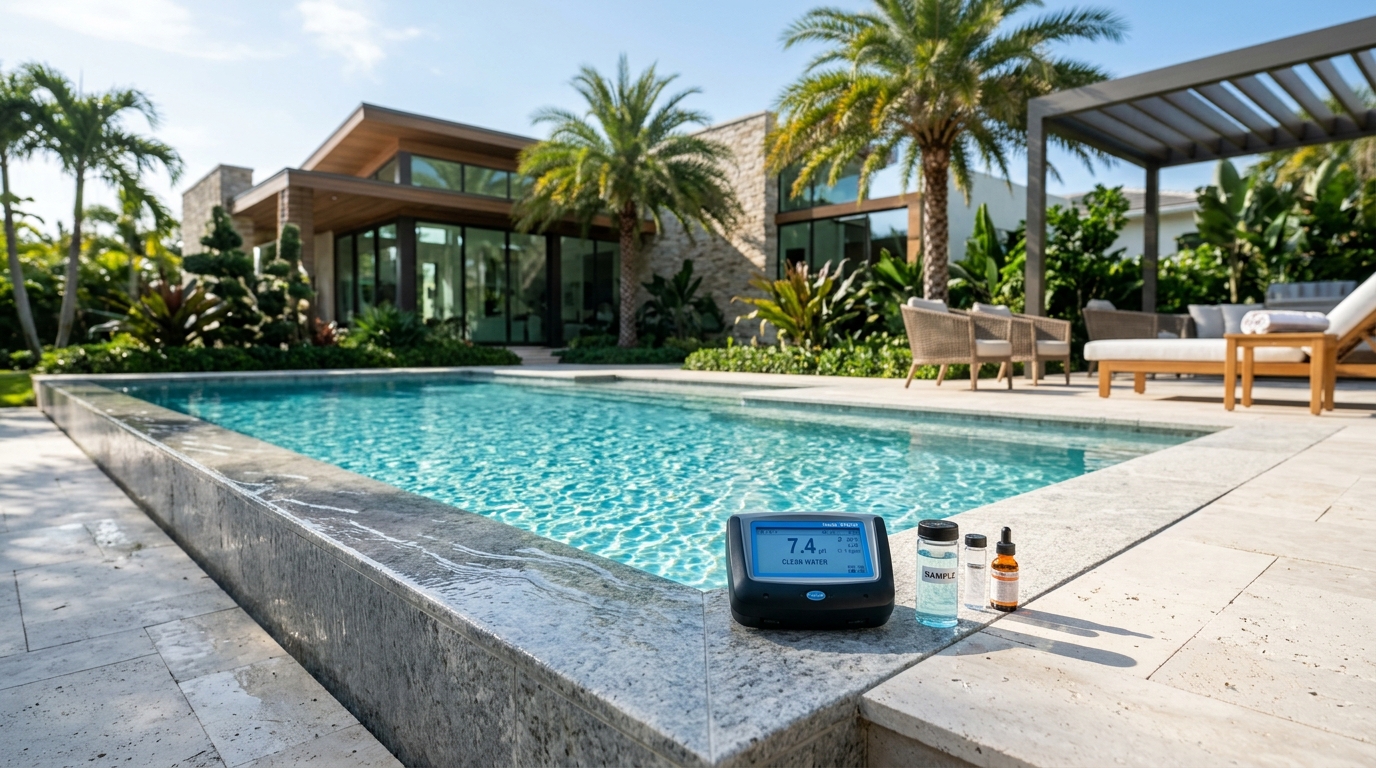
Most pool owners spend between $600 and $1,200 every summer buying unnecessary 'clarifiers', 'shock packs', and 'algaecides' pushed by brick-and-mortar pool stores.
In our aquatic testing lab, commercial swimming pool balance is governed by simple inorganic chemistry: Free Chlorine (FC), pH, Total Alkalinity (TA), Calcium Hardness (CH), and Cyanuric Acid (CYA). When these five parameters align, your water remains crystal clear, prevents algae spore division, and feels soft on the eyes with zero skin irritation.
Select your pool size and test readings to calculate exact fluid ounces and pounds of chemical additions with zero guesswork.
Total Alkalinity (TA) represents the water's buffering capacity against acid spikes. If TA is below 60 ppm, adding even a splash of muriatic acid causes pH to crash into corrosive territory (<7.0). Use ordinary grocery-store sodium bicarbonate (baking soda) to raise TA to 80–100 ppm before attempting to fine-tune pH.
When pool pH climbs above 8.0, over 80% of your free chlorine converts into inactive hypochlorite ions (OCl-), which disinfect 100 times slower than active hypochlorous acid (HOCl). Pour 31.45% muriatic acid into the deep-end return jet stream to bring pH down into the 7.4–7.6 sweet spot.
The greatest myth in pool care is that '1 to 3 ppm of chlorine is always safe'. In reality, active chlorine is chemically governed by your Cyanuric Acid (CYA) concentration. Your minimum Free Chlorine must always be at least 7.5% of your CYA level (e.g., at 40 ppm CYA, you need at least 3.0 ppm FC). Drop below this threshold, and yellow or black algae will take hold within 48 hours.
High-contrast, 1-page emergency reference chart calibrated per 10,000 gallons. Chemical dosing tables, safety matrix, and algae eradication checklist.