How to Calculate Solar Generator Battery Run Time (Step-by-Step)
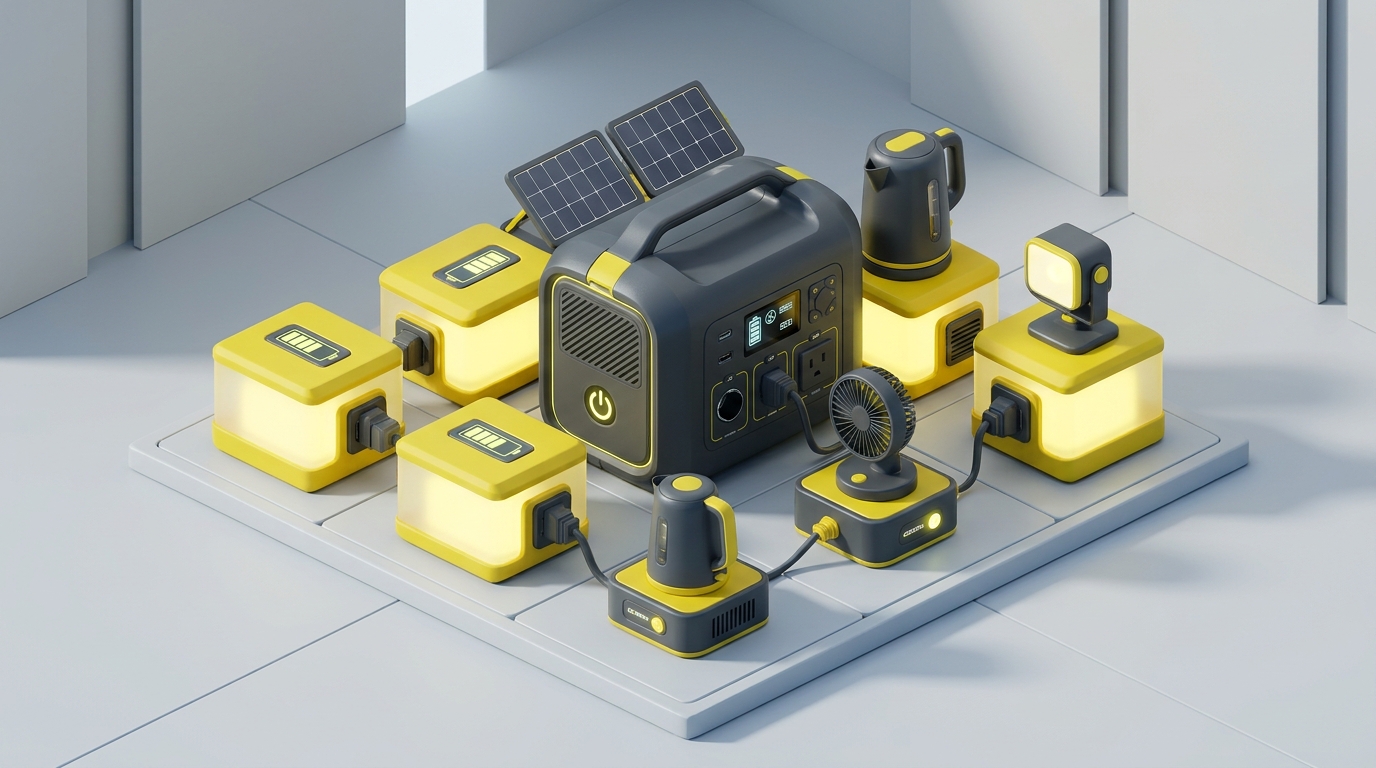
If you just bought an EcoFlow, Jackery, or Bluetti power station, you probably noticed the box says "1000 Watt-Hours (Wh)". But when you plug in your 100-watt mini fridge, it dies in 8 hours instead of 10. Why?
You didn't get ripped off — you just got hit by the Inverter Efficiency Tax. In this guide, we'll teach you the exact modular formula used by electrical engineers so you can predict exact battery runtime down to the minute.
Actual Hours = (Rated Battery Wh × 0.85) ÷ Appliance WattsAlways multiply total Wh by 0.85 to account for the pure sine wave inverter DC-to-AC conversion loss and battery management system (BMS) reserve.
Your power station stores direct current (DC) energy in its internal lithium iron phosphate (LiFePO4) cells. But home appliances (like your TV, blender, or fridge) run on alternating current (AC).
The built-in inverter converts DC to AC, and that process creates heat. High-end inverters operate at 85% to 90% efficiency.
1,024 Wh × 0.85 = 870.4 Usable Watt-Hours.Appliances with compressors or electric motors (refrigerators, blenders, power tools, water pumps) need 3x to 5x their normal wattage for the first 2 seconds to kickstart the motor.
- Continuous (Running) Watts: What it uses while humming along.
- Surge (Peak) Watts: The initial burst when the compressor kicks on.
Here is what common off-grid appliances actually pull from an AC inverter:
| Appliance | Average Watts | Surge Watts | Expected Run on 1000Wh |
|---|---|---|---|
| ResMed CPAP (No Heat) | 35W - 45W | 45W | ~21.7 Hours |
| 12V Car Refrigerator (Dometic) | 45W - 60W | 150W | ~14.5 Hours |
| Starlink Standard Dishy | 50W - 75W | 100W | ~14.0 Hours |
| MacBook Pro 16" Fast Charge | 96W - 140W | 140W | ~7.5 Full Charges |
Verified Power Stations Tested Against This Formula
Cross-referenced against our 85% inverter discharge benchmark. Compare real Wh ratings before buying:
EcoFlow DELTA 2
Jackery Explorer 1000 Plus
Anker SOLIX C1000
Let's calculate how long an EcoFlow DELTA 2 (1,024 Wh) will power a 50W Starlink terminal in your camper van:
Here is the biggest rookie mistake: leaving the AC button turned ON when nothing is plugged in.
A 1,800W pure sine inverter consumes between 15W and 25W per hour just staying awake waiting for something to be plugged in. Over a 10-hour night, that's 200Wh lost to thin air!
Download the Solar Runtime Excel & PDF Sheet
Input your battery capacity and pick from 80 appliances to get an instant runtime bar chart.