Cosori TurboBlaze•Featured Sponsor
Cosori TurboBlaze 6.0-Qt Air Fryer (Master Edition)
Direct current brushless motor with 5 variable fan speeds. Cuts cooking times by up to 60% compared to standard bake ovens.
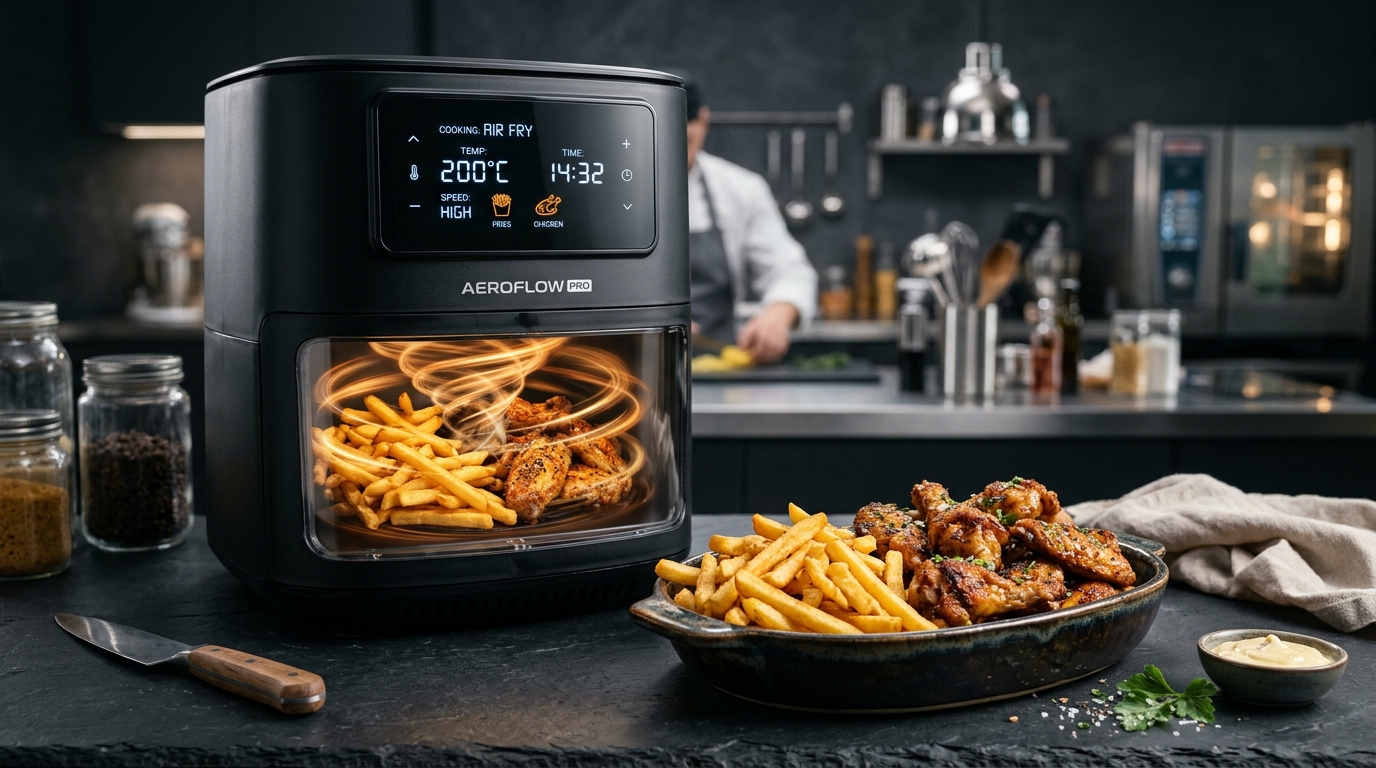
Have you ever thrown your favorite oven casserole or chicken thigh recipe straight into an air fryer at the same temperature and time, only to end up with blackened edges and an undercooked center?
You didn't ruin the food — you violated the laws of convective heat transfer. A standard residential oven heats a cavernous 3 to 5 cubic feet of static air. An air fryer circulates superheated air inside a tight 5 to 8-quart chamber with an 1,800-watt fan. To get restaurant-grade crispness without drying out proteins, you must adjust both thermal intensity and cook duration.
Enter your original oven recipe instructions below. The calculator immediately applies the aerodynamic convection multiplier and gives you the exact time, temperature, and shake alerts.
Pat chicken skin completely bone-dry with paper towels before seasoning. Residual water turns to steam, delaying the Maillard reaction by up to 6 minutes. Avoid sugary glazes until the last 3 minutes of cooking to prevent burning.
In thermal physics, heat moves through food by conduction, but the surface is heated by radiation and convection. Because an air fryer's heating element is inches from the food, 400°F in an air fryer acts more aggressively on surface fats than 400°F in an oven.
The Action: If a recipe calls for 400°F in an oven, dial your air fryer to 375°F. If it calls for 350°F (common for cakes and quick breads), dial down to 325°F. This gives internal meat fibers time to reach safe temperatures before exterior proteins turn tough and acrid.
Because the cyclonic fan rapidly strips the insulating "cold boundary layer" of humid air from around the food, heat enters the food mass much faster.
Golden Rule of Thumb: Always check doneness at least 5 minutes before the recalculated time with an instant-read probe thermometer.
The number one reason home cooks fail to achieve crispness is crowding the basket. When chicken wings or fries touch and overlap, escaping moisture is trapped between pieces. Instead of air-frying, you are essentially steaming your food.
Keep foods in a single layer with at least 0.25 inches of clearance between pieces. If cooking for a family of 4, cook in two quick batches — the first batch will remain hot while the second cooks in half the time of an oven.
You do not need cups of oil, but you almost always need a fine micron mist. Oil acts as a thermal bridge, conducting heat evenly into micro-crevices.
| Food Item | Oven Standard | Air Fryer Recalibrated | Midway Action |
|---|---|---|---|
| Chicken Wings (Fresh) | 425°F for 40 mins | 390°F for 18-20 mins | Shake vigorously @ Min 10 |
| Frozen French Fries (1 lb) | 450°F for 25 mins | 400°F for 13-15 mins | Shake twice @ Min 6 & 11 |
| Salmon Fillet (6 oz) | 400°F for 15 mins | 380°F for 8-10 mins | No flip required (skin down) |
| Pork Chops (1-inch thick) | 400°F for 22 mins | 375°F for 12-14 mins | Flip @ Min 7 |
| Chocolate Chip Cookies | 350°F for 12 mins | 320°F for 7-8 mins | Check crust @ Min 6 |
Over 120 verified conversions for poultry, meats, vegetables, frozen convenience foods, and internal meat temperature targets. Ready to laminate and stick on your fridge.